Australian Expat Tax Accounting & Advice

Whether you are working overseas for a few months, relocating long‑term, or running a global career while keeping ties to Australia, getting Australian expat tax right matters.
Determining tax residency is dependent on an individual’s personal circumstances and can involve complex assessments.

melbourne cityscape

As a specialised Australian international tax accounting firm, our dedicated team provides comprehensive services to Australian expatriates across the globe. We have extensive experience assisting expatriates in navigating complex tax issues worldwide, supporting clients from all parts of the world and ensuring their compliance wherever they are.

The rules around tax residency, double tax agreements, property, investments, employee shares, crypto, and student loans can change what you declare, where you pay, and when you lodge. Below is a practical guide from an Australian expat tax accountant on how the system works, the traps & pitfalls to avoid, and how expert expat tax advice in Australia keeps you compliant and tax‑efficient. 

First step: work out your Australian tax residency

Australia uses four residency tests for individuals – the resides, domicile, 183‑day, and Commonwealth super tests. These tests are used to determine your tax residency status, which affects whether Australia taxes your worldwide income or only your Australian‑sourced income. The ATO explains how the tests work and how to assess your position.

These four tests are the means by which the ATO determines your tax residency status.

If you are also treated as resident elsewhere, a Double Tax Agreement (DTA) may apply tie‑breaker rules to resolve dual residence for treaty purposes. In practice, the treaty looks at permanent home, centre of vital interests, habitual abode and nationality, applied in order.

It is important to understand your tax residency status before leaving Australia, as this can have significant tax implications. Understanding the rules of tax residency can prevent unforeseen tax issues upon departing and returning  to Australia.


What changes if you become a foreign resident for tax

If you are a non‑resident for Australian tax purposes:

  • You are only liable for Australian tax on your Australian-sourced income and do not claim the tax‑free threshold. You can usually claim a Medicare levy exemption for the non‑resident period when you lodge.
  • Interest, unfranked dividends and royalties you receive from Australia are typically taxed by withholding at source and are not included in your return if the correct amount was withheld.
  • For capital gains, you are generally only taxed on taxable Australian property such as direct interests in land and certain indirect real property interests. Foreign residents only pay CGT on taxable Australian property and typically do not receive the 50% CGT discount for assets held during non-residency.

If you have taxable income from Australian sources as a non-resident, you are still required to complete an Australian tax return to report this income and meet your tax obligations.

australian expat in sydney

Owning Australian property while overseas

Rental income and deductions

You can continue to claim rental deductions, including interest, repairs and eligible capital works, if the property is genuinely available for rent. Keep records and apply the rules consistently. Ensuring accurate reporting of rental income and deductions is essential to avoid penalties and minimise penalties from the ATO.

Selling Australian property

Two issues commonly catch out expats:

  1. Foreign Resident Capital Gains Withholding (FRCGW). From 1 January 2025, purchasers must withhold 15% on all contracts with a foreign‑resident vendor, with no monetary threshold. The rate and scope depend on the contract date, so check the ATO examples. Australian residents avoid withholding by providing a valid clearance certificate before settlement. Complying with FRCGW withholding and reporting requirements is important for minimising penalties and ensuring you meet your tax obligations.
  2. Main residence exemption. If you are a foreign resident at the time of disposal, you generally cannot claim the main residence exemption, except in limited circumstances set out by law.

Timing matters

For CGT, the event date is usually the contract date, not settlement. That timing affects your residency status, discount eligibility and which rules apply.


Moving day planning: CGT Event I1 and the “exit tax”

When you cease to be an Australian resident, a deemed disposal of most non‑TAP assets is taken to occur at market value at the time you stop being resident, commonly called the “exit tax” or CGT Event I1. You may choose to crystallise the gain in that year, or make a deferral choice so the gain is recognised when you later dispose of the asset.

Australian real property is excluded from the deemed disposal. Individuals may need to maintain documentation of foreign tax paid and record the value of overseas assets for CGT purposes if they cease to be an Australian resident.

Good records of market values on departure, and treaty interaction if you later sell while non‑resident, are essential. Good records are required to support your position and choices.

If you remain an Australian resident while working overseas

Residents are taxed on worldwide income. If you pay tax overseas on the same income, you may be entitled to a Foreign Income Tax Offset (FITO), subject to eligibility and offset limits. This prevents double taxation up to Australian tax otherwise payable on that income. The ATO’s FITO guide explains the rules and record‑keeping.

It is important to understand your ongoing tax obligations as an Australian resident working overseas to ensure compliance with Australian tax laws.

Double Tax Agreements in practice

DTAs allocate taxing rights and contain tie‑breaker rules for dual residents. The ATO’s ruling on interpreting treaties and the UK’s guidance make clear how the tie‑breaker sequence works and when you fall to one state or the other for treaty purposes. 

Keep in mind your domestic residency status may remain different even if the treaty treats you as resident elsewhere for particular income.

It is important to discuss your treaty position with a professional who can provide tailored advice on your residency and tax obligations.

Australian Expat Tax Return Overview

The financial year runs from 1st July to the following 30th June.

Australian citizenship does not affect your residency position. Non-resident tax returns are only required in relation to Australian sourced income only and certain dividend distributions along with foreign sourced income due to HECS & HELP reporting purposes only.

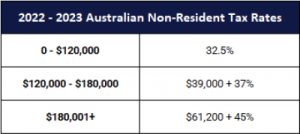
Non Resident Tax Rates 2026

$0 – $135,000 30c for each $1
$135,000 – $190,000 $40,500 + plus 37c for each $1 over $135,000
$190,001 + $60,850 + plus 45c for each $1 over $200,000

Tax-Free Threshold

The tax-free threshold is not available to non-residents of Australia.

Late filing penalties

You may receive a Failure To Lodge (FTL) on time penalty if you do not lodge on time.

Australian Expat Tax Deductions And Exemptions

Claiming a deduction for a Work Related Expense:

  • You must have spent the money personally and have not be reimbursed by your employer
  • The expense must be directly related to earning your income
  • You must provide a receipt

Such expenses can include:

  • Union fees
  • Professional courses
  • Reference books
  • Tools & equipment
  • Motor vehicle
  • Working from home

Superannuation Contributions

You may be eligible to claim a deduction for additional superannuation contributions paid on the basis that you have sufficient unused contribution limits to be used and you have provided a notice of intent to your superannuation fund.

You can continue to make superannuation contributions as a non-resident of Australia however, you may be worth obtaining professional financial advice before doing so as to what this may mean in the event of you not returning to Australia.

Please note: superannuation contributions cannot create a loss.

Lodging from overseas and deadlines

You can lodge online from overseas via myTax if your myGov is linked to the ATO, or you can lodge through a registered tax agent. Tax agents often have access to extended lodgment program dates if you are on their lodgment portal prior to 31st October.

Even when lodging from overseas, you must complete your Australian tax return in full and send it to the ATO to ensure compliance with your tax obligations. Australian expats with recurring income in Australia need to submit a tax return each year.

Country snapshots for frequent expat corridors

big ben uk

The UK uses the Statutory Residence Test (SRT) with split‑year treatment in certain cases. If you are dual resident, then you must apply the Australia‑UK DTA tie‑breaker.

Coordination between ATO rules and UK SRT is essential in your first and last UK years. Government policies, including proposed changes to tax residency rules and ongoing consultations, can significantly impact your tax residency status and obligations.

singapore

Singapore taxes employment income sourced in Singapore and generally exempts foreign‑sourced income remitted by individuals, subject to conditions. Review your tax residency position and DTA relief if you work cross‑border.

hong kong

Maintains a territorial system, salaries tax applies to income arising in or derived from Hong Kong, there is no Australia–Hong Kong tax treaty, and individuals generally aren’t taxed on capital gains or subject to dividend or interest withholding; MPF contributions of about 5 percent each from employer and employee can apply unless exempt.

If you remain an Australian resident you are taxed on worldwide income with a possible foreign income tax offset for Hong Kong salaries tax; if non-resident for Australia, focus on Australian-source rules.

dubai

The UAE does not levy personal income tax on individuals; however, it has a corporate tax regime and rules on when individuals must register for corporate tax are specific.

Government policies in the UAE can affect your tax residency and obligations, so it is important to stay updated on any regulatory changes. Australian residency and Australian‑source income rules may still pull you back here.

customers reaching for phone to contact

Get in touch

Expert Australian Expat Tax Accounting & Advice

Our team specialises in Australian expat tax advice, offering tailored solutions for Australians living and working overseas. Our experienced tax advisors understand the unique challenges faced by expats, including complex residency and cross-border tax issues.

With years of experience, we provide expert guidance and a clear understanding of your obligations, giving you peace of mind throughout the process. We are committed to delivering personalised support so you can navigate your tax matters with confidence and clarity.

  • Confirm your residency under ATO tests and relevant DTA.
  • Map your income and gains, then apply FITO correctly.
  • Structure property and investment decisions, including FRCGW and main residence issues.
  • Review ESS, crypto, and trust exposures and coordinate with foreign advisers.
  • Lodge from overseas and align with the tax agent lodgment program.
Contact Us

FAQs

No tax‑free threshold applies to non‑residents. Non‑residents can generally claim a Medicare levy exemption for the non‑resident period when they lodge.

Expats may still be subject to certain Australian taxes, such as capital gains tax on Australian property and withholding tax on Australian-sourced income. Foreign residents can only claim deductions related to their Australian-sourced assessable income and not for expenses related to earning foreign income.

Check residency on the contract date, FRCGW obligations, whether you qualify for a resident clearance certificate, and whether the main residence exemption is available.

The 6-year main residence exemption for capital gains has been limited for foreign residents since July 1, 2020, impacting their eligibility when selling Australian property unless life event tests are met..

If you remain an Australian tax resident, you declare worldwide income and may claim FITO for foreign tax paid. If you cease residency, the answer depends on Australian‑source rules and any applicable DTA. Australian tax residents are taxed on their “worldwide income” at a maximum taxable rate of 45%.

Use ATO‑published RBA rates or an acceptable alternative and follow the translation rules. Consistency is important.

You must notify the ATO and report your worldwide income each year by the deadline. Amounts due are assessed after you report.

If you need personalised support or have questions about your Australian expat tax situation, please get in touch with us for expert assistance.

As a non-resident no however, if you are considered a tax resident then your overseas income may be taxable in Australia.

london cityscape

Book a consultation